
AI-gile
A P33 Proprietary Delivery Methodology for the GenAI Age
Proprietary Methodology
A P33 Proprietary Delivery Methodology for the GenAI Age
Proprietary Methodology
The emergence of Generative AI coding tools — Claude Code and its competitors — has fundamentally broken the core assumptions of standard Agile methodology. When AI can generate a working prototype in days that would previously have taken a team of developers weeks or months, the bottleneck is no longer code creation — it is validation, production hardening, and accountability.
AI-gile is P33's response to this shift. It is not merely Agile with AI tools added — it is a fundamentally re-engineered delivery methodology that matches team structure, cadence, and governance to the capabilities and risks of GenAI-accelerated development.
The Core Innovation
A team of four highly specialised individuals that consistently outperforms a standard Agile team of eight to ten — delivering 3–5× faster end-to-end, with 10–20× faster time to first working prototype.
Standard Agile was calibrated to human coding velocity. Every ceremony it prescribes — sprint length, story point estimation, daily standups, sprint reviews — was designed around one central assumption: that code creation is slow, deliberate, and constrained by human typing speed and cognitive load.
With GenAI developer tools, the constraint has moved from creation to validation. The questions that now govern a project's pace are not "how long will it take to build this?" but rather: Is what the AI generated architecturally sound? Does it meet production standards? Can we trust it? Who is accountable if it fails?
The code arrives fast. The risk arrives with it. Standard Agile has no answer for this.
AI can implement within a structure but cannot own the non-functional requirements that define production viability: scalability under load, resilience patterns, data sovereignty, security posture, compliance boundaries, and integration contracts. These remain human decisions.
AI-generated code can be syntactically correct, functionally plausible, and completely unfit for a regulated production environment. Logging, error handling, audit trails, secrets management, and deployment patterns require human governance.
In financial services, someone must own the decision that code or a model is production-ready. AI cannot carry that accountability. A human must. AI-gile makes this accountability explicit, structural, and non-negotiable.
AI-gile teams are fixed at four people. This is not an arbitrary constraint — it is the product of deliberate design, grounded in both the capabilities of GenAI tooling and well-established principles of team communication dynamics.
| Role | AI Project | Software Project | Sign-off Authority |
|---|---|---|---|
| DomAIn Expert | 1 (required) | 1 (required) | Requirements & Scope |
| GenAI Developer | 1 | 2 | — |
| Build Validator | 1 (required) | 1 (required) | Production Readiness |
| Data Science Validator | 1 (required) | Not required | Model & Data Integrity |
| Total Team Size | 4 | 4 | |
| Communication Channels | 6 | 6 | 83% fewer than Agile 9 |
The two sign-off roles — Build Validator and Data Science Validator — carry fixed authority that cannot be delegated or bypassed. This is a deliberate governance design: speed is achieved in the Burst phase, safety is assured at the Validation Gate.
All other roles may overlap where individual expertise allows, ensuring maximum team efficiency without compromising the integrity of the validation function.
Before a single line of AI-generated code is considered, AI-gile teams enjoy a structural speed advantage over larger Agile teams. This is not intuitive — it is mathematical, and it derives from a principle established in software engineering over 50 years ago.
Brook's Law states that adding people to a late software project makes it later. The deeper insight is that communication overhead grows non-linearly with team size. The number of communication channels in a team of n people is calculated as: n × (n - 1) / 2
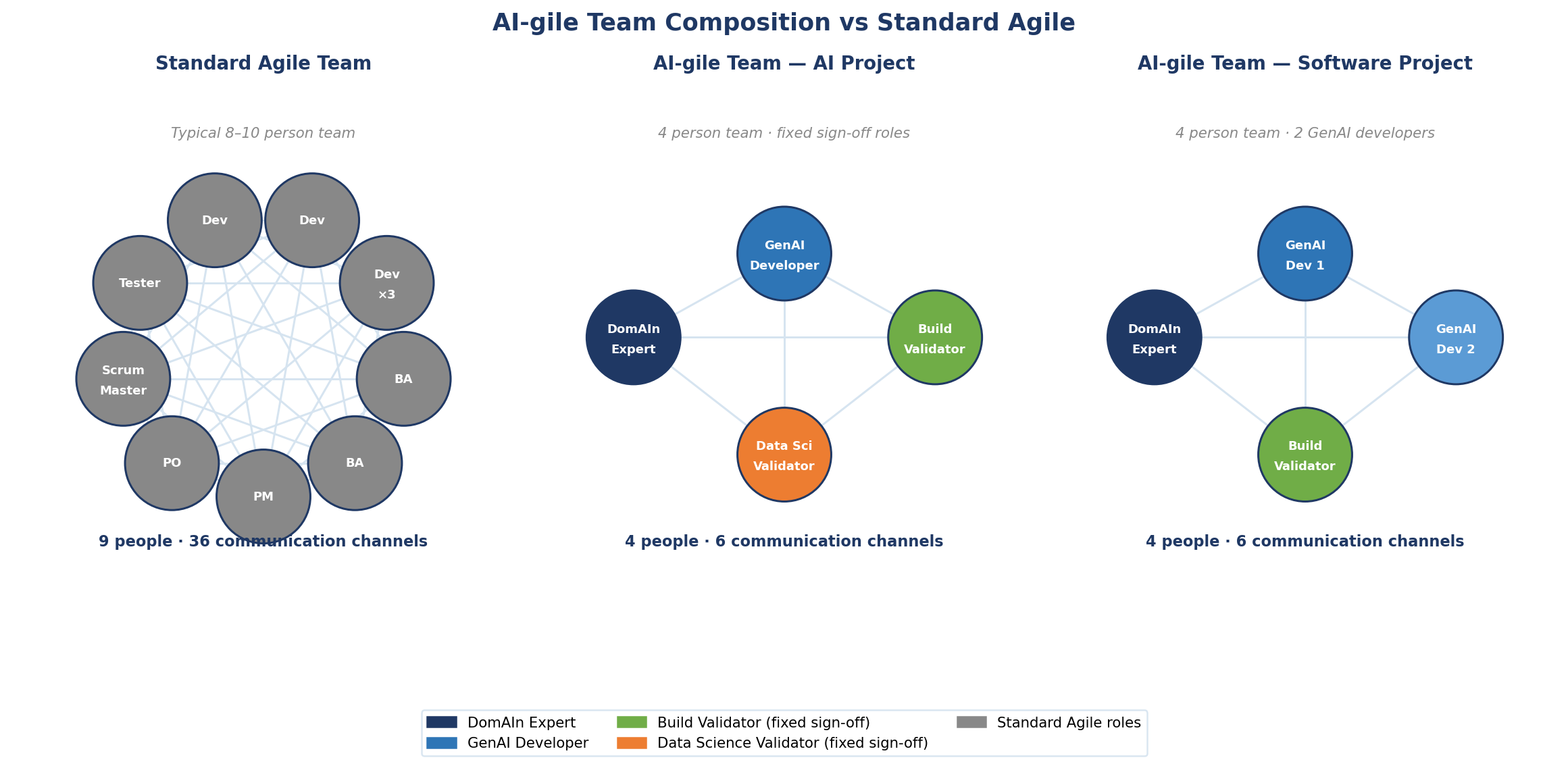
Figure 1: AI-gile team structures vs standard Agile — with communication channel counts
A standard Agile team of nine people manages 36 communication channels. An AI-gile team of four manages 6 — an 83% reduction in coordination overhead. Every decision, every clarification, every blocker resolution happens faster simply because fewer people are involved.
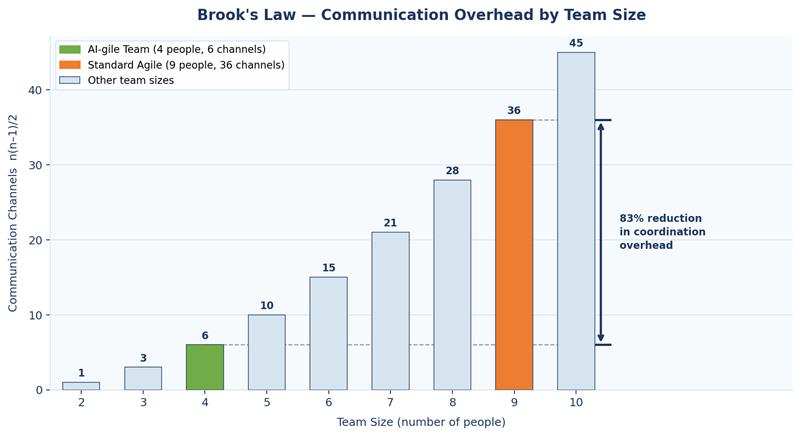
Figure 2: Brook's Law — communication channels grow non-linearly with team size
Smaller teams do not just deliver faster — they cost significantly less. Fewer people means lower day-rate expenditure. Shorter duration means a lower total project cost. For financial services organisations working under fixed budgets and urgent timelines, this is not incidental — it is strategic.
Standard Agile's two-week sprint was designed for human coding velocity. AI-gile replaces it with the Burst model — a rapid, AI-driven development cycle measured in hours or days, followed by a structured validation gate and production hardening phase.
The GenAI Developer acting as prompt architect, generates the functional build. Requirements are expressed not as lengthy specification documents but as precise, structured prompts guided by the DomAIn Expert's domain clarity.
The Build Validator reviews all output against production standards: architecture compliance, security, test coverage quality, integration points, maintainability, and edge case handling. For AI solutions, the Data Science Validator assesses model performance, bias, data quality, and statistical soundness.
What passes the Validation Gate then undergoes the disciplines that GenAI routinely under-delivers: proper logging and observability, deployment pipeline integration, documentation that a human team can maintain, and the edge case handling that production environments demand.
Because Bursts complete in hours, the fortnightly sprint review is redundant. Validated increments are integrated continuously, with a lightweight release decision replacing the sprint ceremony. This eliminates two weeks of artificial waiting time per cycle.
Speed claims in delivery methodology are most credible when they are specific about which phase is faster and by how much. AI-gile's advantages are real and substantial — but they are not uniform across all phases of delivery.
| Delivery Phase | Standard Agile | AI-gile | Speed Advantage |
|---|---|---|---|
| Requirements to Working Prototype | 8–16 weeks | 2–5 days | 10–20× |
| Prototype to Validated Build | 4–8 weeks | 3–10 days | 4–6× |
| Validated Build to Production-Ready | 3–6 weeks | 1–2 weeks | 2–3× |
| End-to-End Project Delivery | 15–30 weeks | 4–6 weeks | 3–5× |

Figure 3: AI-gile vs Standard Agile — typical delivery duration by phase
Prototype phase (10–20×): GenAI code generation is genuinely that fast when requirements are well-formed. The DomAIn Expert ensures they are. What previously required a team of developers working across multiple sprints now completes in days.
Validation phase (4–6×): Validation takes as long as it takes — and that is a feature, not a bug. The speed advantage here comes from the near-elimination of rework: the DomAIn Expert's upfront clarity and the Build Validator's production-first mindset mean that builds rarely fail validation. Standard Agile, by contrast, often discovers architectural or standards issues late in the cycle, requiring expensive rework.
Production hardening (2–3×): This phase is least sensitive to methodology. The gains here reflect the smaller team's lower coordination overhead and the Build Validator's production-first mindset throughout the Burst phase, which ensures hardening requirements are considered from the beginning rather than retrofitted at the end.
Validation is not faster. It is more targeted and more efficient — but the thoroughness of the Build Validator and Data Science Validator is the mechanism by which AI-gile delivers speed that is sustainable and production-grade, not merely fast.
P33 does not charge a premium for the AI-gile methodology. Clients pay for the people and the duration — both of which are substantially reduced. The practical consequence is that AI and software initiatives that would previously have required significant capital allocation can now be delivered at a fraction of the cost — often within operating expense budgets that do not require board approval.
AI-gile is not a theoretical framework — it has been proven in delivery. P33's projects provide compelling evidence across every phase of the methodology.
P33's development speed under AI-gile is now such that we build working prototypes for clients rather than PowerPoint presentations. Where other consultancies present slides describing what a solution might look like, P33 delivers functional software that clients can test and interact with.
At the full project level, a document intelligence solution built using the AI-gile team structure won a major international bank's internal innovation competition — demonstrating that AI-gile output quality meets the standards of large institution governance.
Most significantly, a complex financial software replacement project — taken all the way to production — was delivered by a four-person team in six weeks. This is the end-to-end AI-gile model working under real-world constraints with real-world accountability.
P33 embeds a DomAIn Expert into every engagement — a senior practitioner with deep financial services domain knowledge and comprehensive expertise in how AI is built, governed, and safely deployed in regulated environments.
The DomAIn Expert occupies the intersection of three disciplines rarely found in one individual: financial services domain mastery, AI capability and implementation knowledge, and responsible AI governance. They translate business requirements into AI-ready specifications, identify regulatory and compliance constraints before they become blockers, and ensure that what is built aligns with both technical feasibility and business value.
The GenAI Developer is the engine of the Burst phase. Their primary skill is no longer writing code in the traditional sense — it is directing AI development tools with precision, recognising when AI output is production-viable and when it requires human intervention, and translating the DomAIn Expert's requirements into prompts that produce architecturally sound, maintainable code.
The Build Validator holds fixed sign-off authority on all production readiness decisions. They are a senior engineer whose primary contribution is ensuring AI-generated code meets the standards required for deployment in a regulated financial services environment: security, resilience, observability, maintainability, and compliance with internal architectural standards.
Present on AI solution projects, the Data Science Validator holds fixed sign-off authority over all model and data integrity decisions. They verify that statistical methods are sound, that cross-validation is properly implemented, that bias and fairness concerns are addressed, and that model performance claims are substantiated by proper evaluation.
The financial services institutions that will lead their sectors over the next decade are not those who are simply aware of AI — they are those who deploy it with precision, govern it with rigour, and integrate it into production at pace.
P33 invites you to bring us your most complex, most urgent, or most long-standing challenges — the problems your teams have not been able to crack, the AI initiatives that have stalled in governance, or the software replacements that have been deferred year after year because the risk or cost seemed too high.
What to Expect
In a typical engagement, your stakeholders will see a working prototype within days, not months. Your governance and compliance teams will have a structured validation framework from day one, not a retrospective justification. And your project will be delivered by a team of four that costs less and moves faster than the alternative you were considering.
The pace of AI development is not slowing. The institutions that establish effective AI delivery capability now will compound that advantage every year. Those that wait for a perfect moment, a larger budget, or a clearer strategy will find themselves increasingly disadvantaged by competitors who moved first.
AI-gile engagements can be delivered in two configurations, and P33 will work with each client to determine the right approach for their environment and data governance requirements.
Where the client permits, P33 deploys the AI-gile team and tooling directly within the client's own infrastructure. This keeps all data, models, and code within the client's security perimeter from day one. It requires client infrastructure access and compliance with internal tooling policies.
P33 can always deliver AI-gile engagements from its own secure environment, with outputs transferred to the client at each Validation Gate. This model requires no infrastructure access or tooling setup from the client and allows P33 to move at maximum speed. It is suitable for projects where data can be anonymised or synthetic data can be used during development.
AI-gile is a methodology developed by P33 for GenAI-assisted delivery, and the approach we use in our own development. We built it because GenAI has created a new class of delivery risk — the risk of moving so fast that governance, accountability, and production readiness are treated as afterthoughts rather than structural requirements.
AI-gile teams are structurally smaller, mathematically faster, and deliberately governed. They do not replace the expertise of large teams — they concentrate it where it matters, eliminate the coordination overhead, and match the pace of development to the pace of validation.
The conversation starts with your challenge. P33 will bring the methodology, the expertise, and the team to turn it into something that works — faster than you might expect, and built to last.
For more information on how AI-gile can accelerate your most critical initiatives.
www.prospect33.com